Counterfeit Card Alert: 1980 Topps #482 Rickey Henderson
Posted on 5/6/2025
In December 2024, Major League Baseball lost one of its most beloved former players when the league's all-time leader in stolen bases, Rickey Henderson, passed away at the age of 65. As the league and fans mourned the passing of the MLB legend, baseball card collectors revisited their collections, as the former Oakland Athletics star's collectibles saw renewed interest in recent months.
Recognized as baseball's greatest baserunner and leadoff hitter, Henderson owns several MLB records, including career stolen bases (1,406), stolen bases in a single season (130), career runs (2,295), unintentional walks (2,129), leadoff home runs (81) and more. A 10-time All-Star, 1990 AL MVP, three-time Silver Slugger Award winner, 1981 Gold Glove Award winner and two-time World Series champion, he was inducted into the Baseball Hall of Fame in his first year of eligibility in 2009.
 |
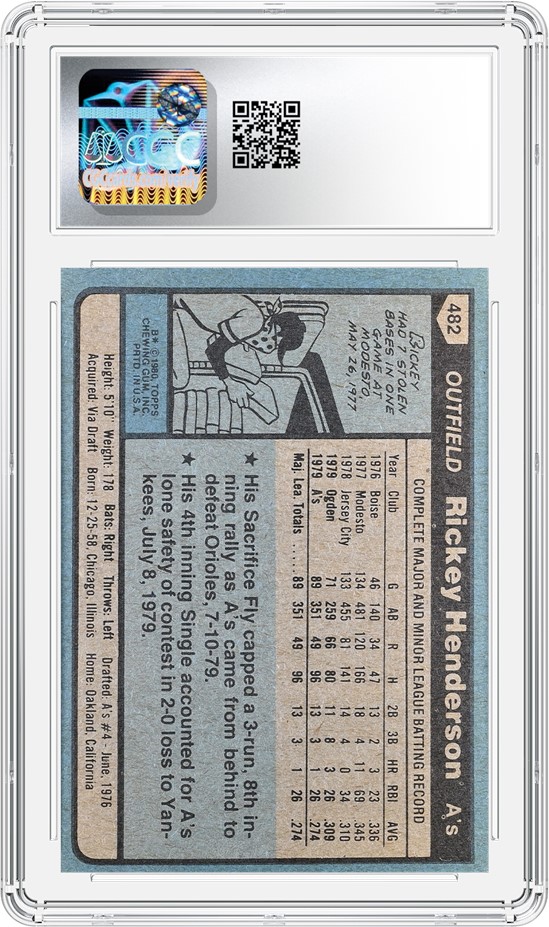 |
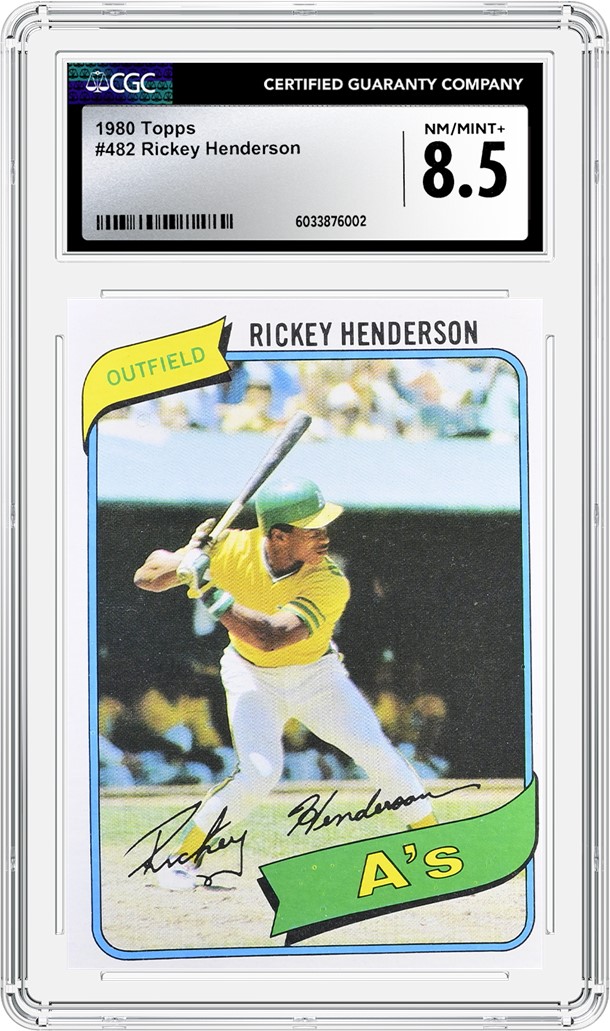
| An authentic 1980 Topps #482 Rickey Henderson graded CGC 8.5 Click images to enlarge. |
|
Henderson's iconic career and popularity off the field helped drive his cards as a popular collectible during his career and long after. As with any athlete who is a fan favorite, Henderson's earliest cards and his rarest cards are often coveted collectibles. And when there is interest and value, it makes for the perfect target for counterfeiters looking to profit. In fact, several versions of counterfeit 1980 Topps #482 Rickey Henderson rookie cards are known to circulate within the hobby.
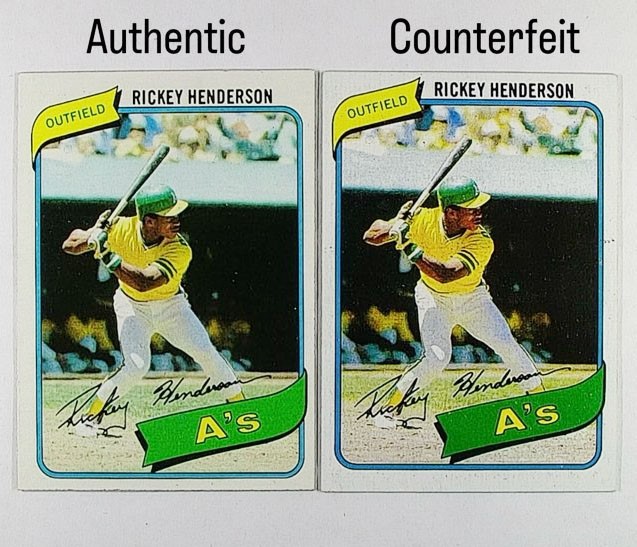
Recently, a purported 1980 Topps #482 Rickey Henderson rookie card arrived at the grading room, which in Gem Mint 10 condition can be worth six figures. However, CGC Cards experts quickly noticed several red flags that aided in detecting the card as a counterfeit issue.
 |
|
| Front views of an authentic and counterfeit 1980 Topps #482 Rickey Henderson rookie card. | |
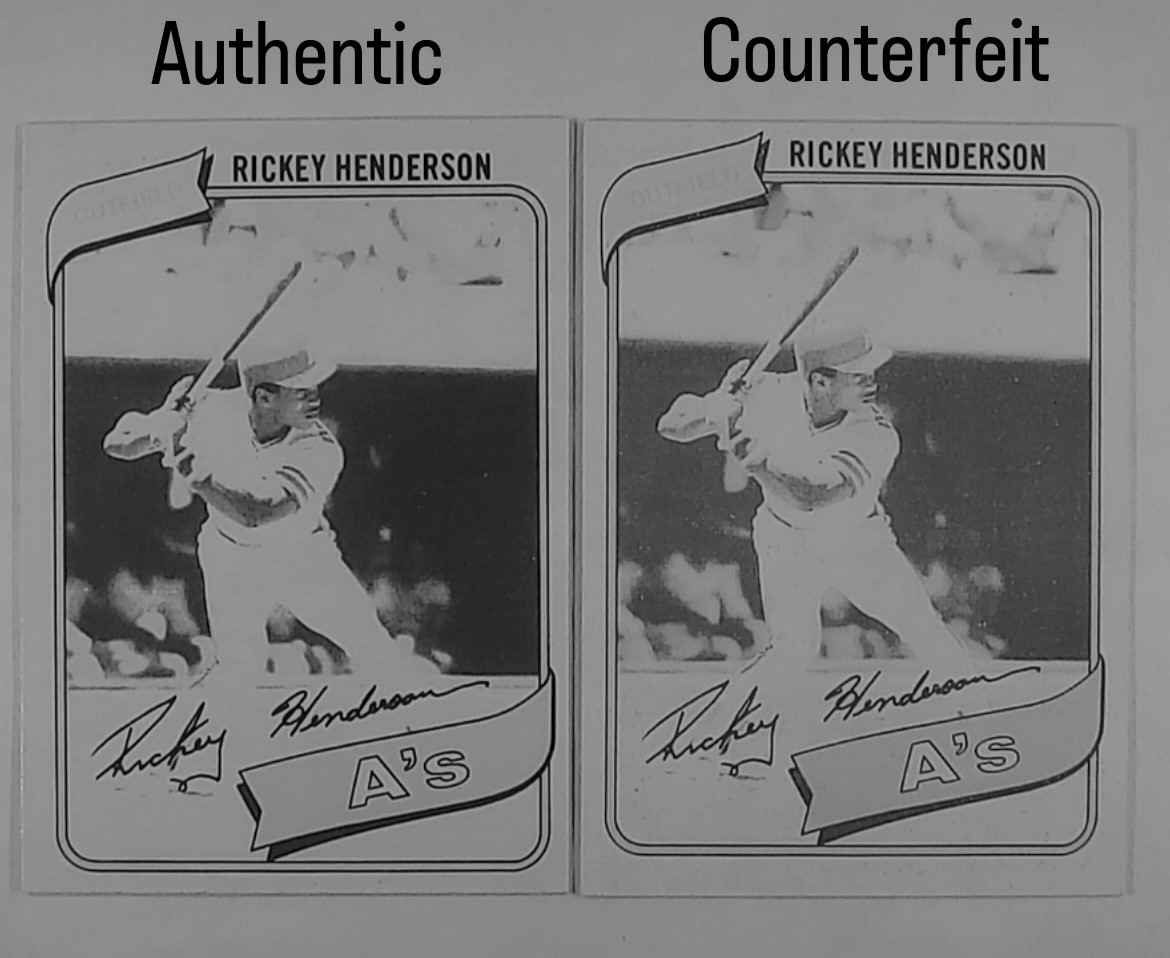
At first glance, the uneducated eye might not catch the glaring differences between authentic and counterfeit copies of the Henderson rookie card. However, under a good infrared (IR) light source, the differences are easier to see, such as the ink used during the printing process. Although it is a subtle difference, the authentic version shows darker and richer ink tones throughout compared to the counterfeit copy.
 |
|
| Front views of an authentic and counterfeit 1980 Topps #482 Rickey Henderson rookie card under infrared lighting. | |
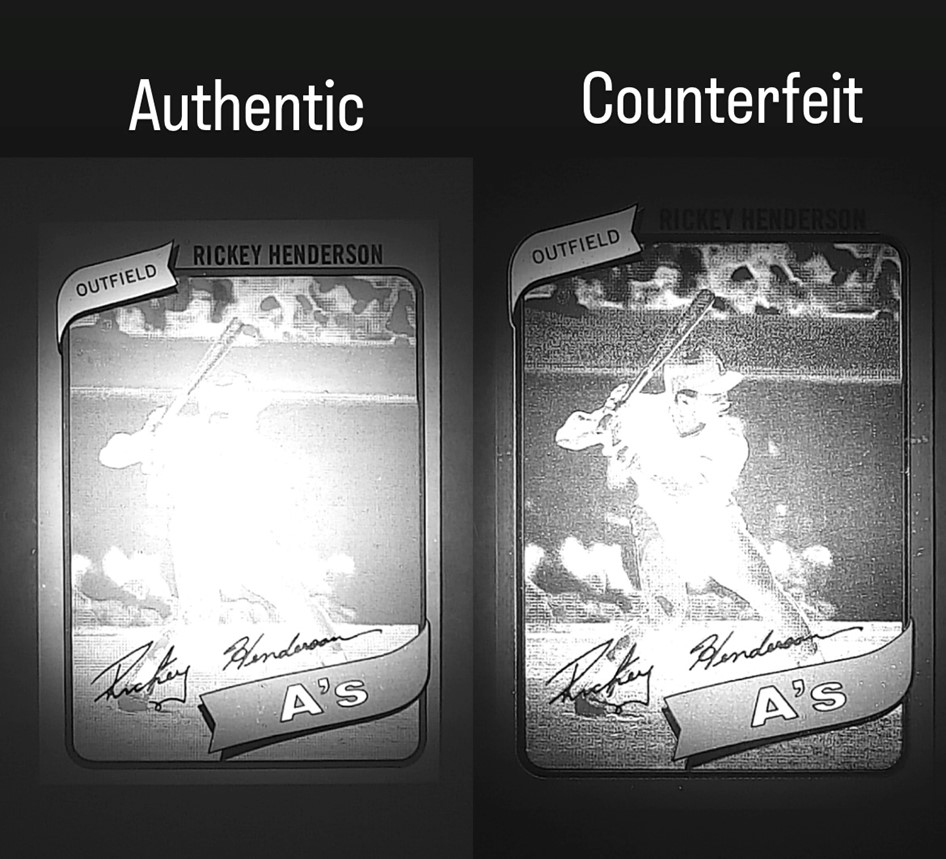
In addition, when the card is tilted back and forth under the IR lighting, the sheen shows differences in the card stock of the counterfeit in comparison to an authentic card. The authentic version is smooth throughout, with very little break in the ink. Meanwhile, the counterfeit shows ink breaks in the dark background where the ink is not as consistent throughout the card.
 |
|
| Front views of an authentic and counterfeit 1980 Topps #482 being sheened under infrared lighting. | |
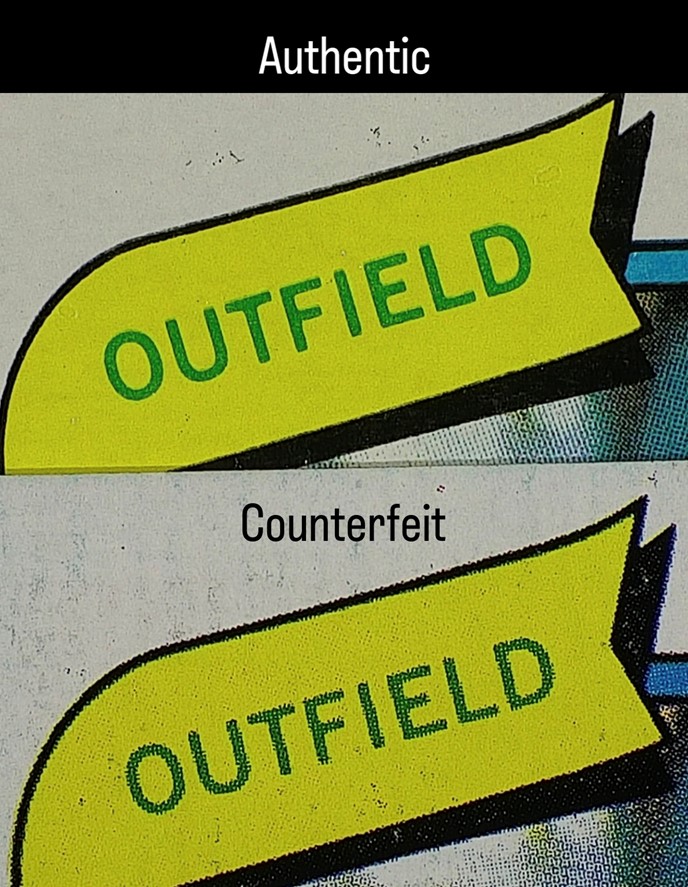
Zooming in on each of the cards helps identify further red flags. This particular fake card has a few key areas of identification, including Henderson's name, position banner and facsimile signature. Close-up views of the front of the card show multiple inconsistencies. Once again, the ink used does not match an authentic copy. Note the slightly brighter coloring of the yellow in the background of the position banner and also the thin blue border below "RICKEY."
 |
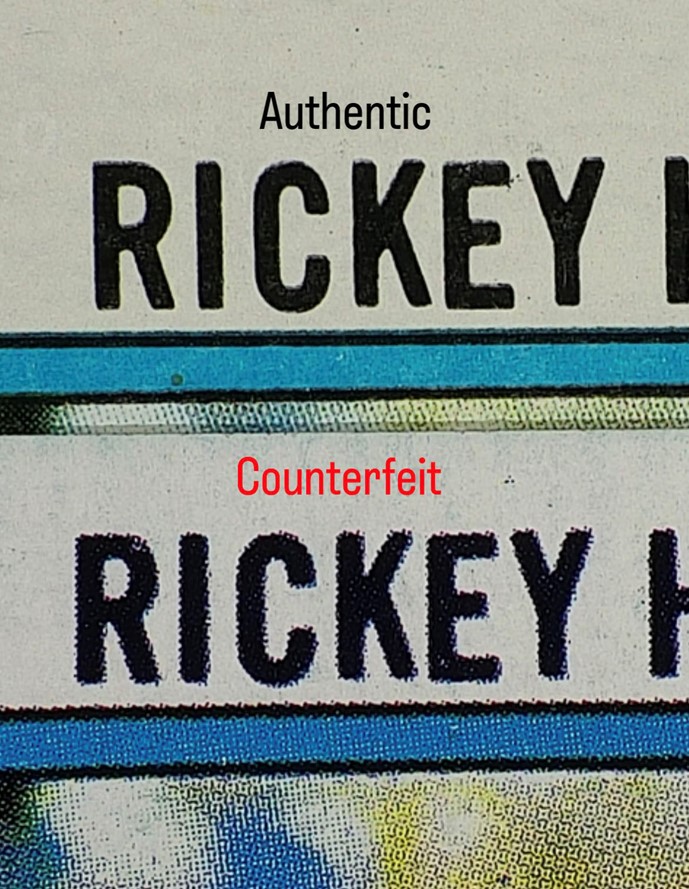 |
| Zoomed-in views of Henderson's position banner and name on an authentic and counterfeit card. | |
Other issues are seen when analyzing the text on the front of the card. Close-up views show deficiencies in the printing of the letters, which led to fuzziness on the counterfeit version. On the authentic copy, each letter is more defined. In comparison, the counterfeit copy has less defined lettering, with the ink bleeding, which creates dots around each letter instead of smooth lines.
The zoomed-in images also show further printing issues throughout the background and border of the card. For example, in the thin black and blue border below Rickey's name, the ink should be solid. Instead, we can see that the counterfeit is composed of print dots, a result of being a copy of a copy.
 |
|
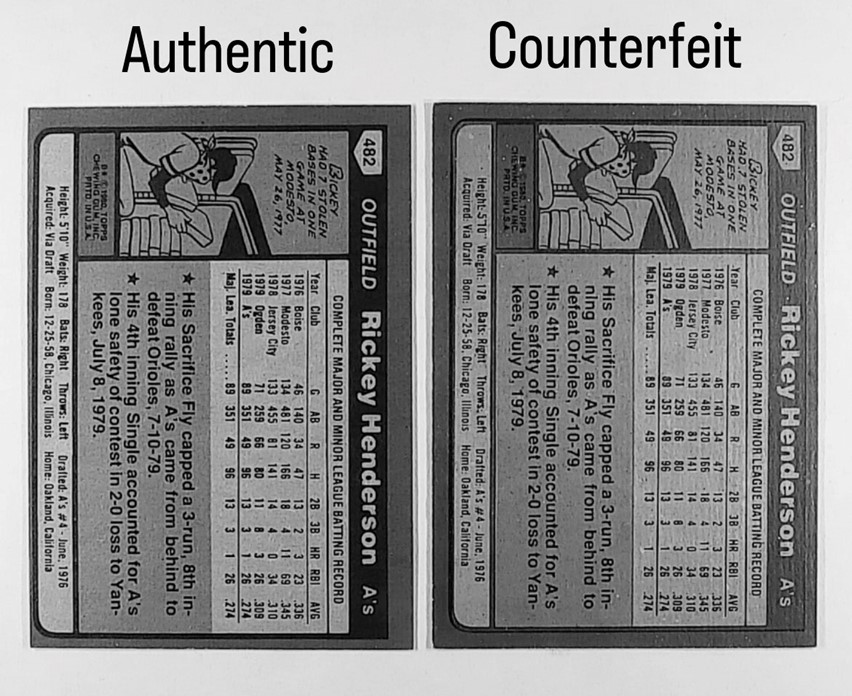
| Back views of an authentic and counterfeit 1980 Topps #482 Rickey Henderson rookie card. | |
The back side of the card echoes the red flags found on the front. Once again, we can tell that the card stock is off and that the overall printing is grainier and more pixelated on the fake copy. It is not as solid in appearance on the counterfeit example, when compared to the authentic version.
 |
|
| Back views of an authentic and counterfeit 1980 Topps #482 Rickey Henderson rookie card under IR lighting. | |
When sheened under the same IR light, the back also shows similar ink issues. The dark ink stands out on the authentic copy compared to the muted coloring on the counterfeit. Card stock differences, ink and coloring issues, blurry text and more stood out across the counterfeit example.
Each of these red flags noted on the front and back of the fake card helped CGC Cards experts determine that it does not match an authentic 1980 Topps #482 Rickey Henderson, like the graded example above. This led CGC Cards experts to make an easy call after careful analysis: The card in question is indeed a counterfeit.
Education is the most important tool when collecting cards. The more collectors know about the printing and manufacturing process of cards, the fewer mistakes will be made when buying cards. This example also highlights the importance of certification for any high-value card.
CGC Cards authenticates, grades and encapsulates authentic examples of cards, making the hobby a safer place for collectors, traders and sellers. To do this, CGC Cards uses world-class expertise, advanced technology, innovation and operational excellence to provide sports card collectors and dealers with accurate and consistent certification services. CGC backs these determinations with the CGC Guarantee, which adds significant confidence, liquidity and value to the hobby. To learn more about CGC's industry-leading services, visit CGCcards.com.
Related Link:
Stay Informed
Want news like this delivered to your inbox once a month? Subscribe to the free CGC eNewsletter today!