How to Read Magic: The Gathering Cards
Posted on 5/7/2026
By
Raeann Calcutta
Magic: The Gathering is widely considered to be the first modern trading card game. Created by Richard Garfield, Magic: The Gathering was released in 1993 to critical acclaim and widespread success, turning the world of tabletop gaming on its head. By 2023, MTG had more than 50 million players and had generated more than $1 billion in annual revenue. Today, Magic: The Gathering is one of the world’s most celebrated trading card games.
Despite the game’s popularity, however, some players and collectors (especially those newer to MTG) find it challenging to understand the many symbols and text boxes on a card, and what they mean — both during gameplay and when looking to determine the collector value of their Magic: The Gathering cards. Fortunately, CGC has certified more than 260,000 Magic: The Gathering cards, and we’re happy to share our expertise on the game.
To start figuring out how to read a Magic: The Gathering card, let’s break down each part of the card and what it means.
Deconstructing a Magic: The Gathering Card
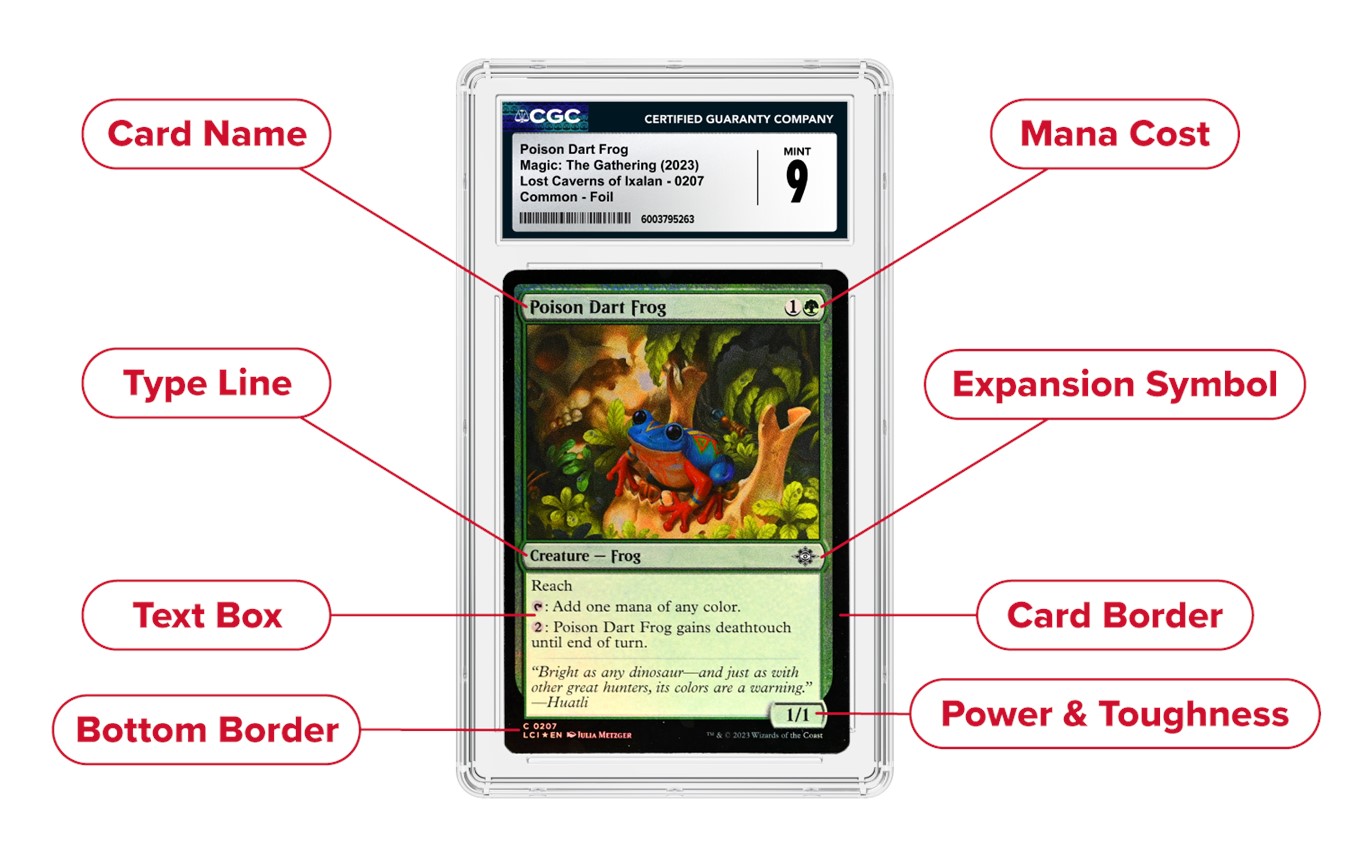
There are eight major parts of a Magic: The Gathering card that allow players to understand how it is played, how rare the card is, and more. In order from top to bottom, they are:
- Card Name
- Mana Cost
- Type Line
- Expansion Symbol
- Text Box
- Card Border
- Power and Toughness
- Bottom Border
Let’s break down what each of these parts mean in Magic: The Gathering.
 |
Card Name
Like other TCGs, each individual Magic card has a name. The card name not only describes the card but also is important to gameplay — many cards will reference others, either as conditions to play a certain spell or another card in the same subtype (more on that later). For example, the card in the image above is named “Poison Dart Frog.”
Mana Cost
“Mana” is the main resource in MTG. Paid for in “Land” cards, mana dictates how much a card costs to play, whether it be a creature, spell, or instant. The symbols tell you the total cost needed to cast. For example, you need one Forest mana and another mana of any type to place Poison Dart Frog on the battlefield.
As of 2026, there are five basic mana types in Magic: The Gathering:
- White (sun symbol)
- Blue (water symbol)
- Red (fire symbol)
- Green (tree symbol)
- Black (skull symbol)
Each color of mana is associated with a specific type of land card. White mana comes from Plains. Blue comes from Islands. Red comes from Mountains, Green comes from Forests, and Black comes from Swamps.
Type Line
In addition to a name, each Magic: The Gathering card has a type line. This line explains the card’s type and subtype (if it has one). For example, Poison Dart Frog is a creature, and its subtype is the creature type Frog. This is important, because certain subtypes in Magic can interact with each other, either by enhancing each other, creating copies of each other, or acting as prerequisites for certain abilities or spells. In other words, the Type Line is extremely important for deck building in Magic: The Gathering.
Expansion Symbol
The expansion symbol indicates which set a particular card was printed in. Since Magic: The Gathering cards are often reprinted, these set symbols help both players and collectors organize their cards and determine which ones are legal for tournament play.
Magic: The Gathering Rarity Symbols
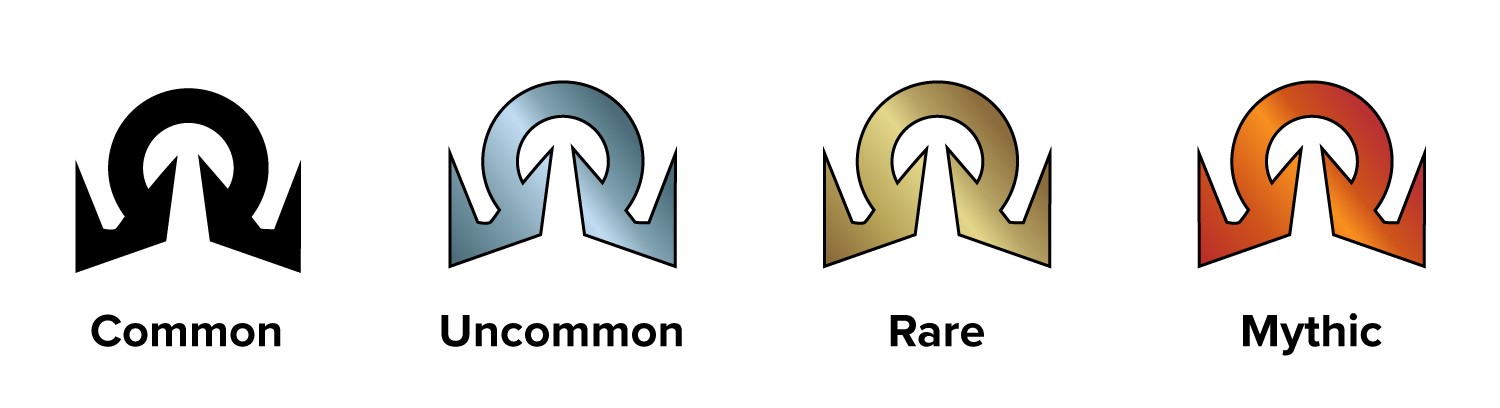
This is a good time to talk about Magic: The Gathering’s rarity symbols. Beginning with Exodus (which was released in 1998), Wizards of the Coast began color-coding expansion symbols to indicate a card’s rarity. Common cards have black symbols, uncommons are silver, and rare Magic: The Gathering cards have gold symbols. Beginning with Shards of Alara’s release in 2008, the mythic rarity was introduced — these cards are even rarer than rare cards and have an orange symbol.
 |
We’ll go into more detail about Magic: The Gathering card rarities in a future article. For now, let’s get back to the card breakdown.
Text Box
The text box is probably one of the most important parts of a Magic: The Gathering card. This part of the card contains information about what the card does in play. Let’s look at Poison Dart Frog’s text box and break it down line by line.
Ability
The first line, “Reach,” describes Poison Dart Frog’s ability. Reach indicates that Poison Dart Frog can attack flying creatures — which are usually immune to attacks from non-flying creatures. Other abilities you may see on a Magic: The Gathering card include Flying, First Strike, Deathtouch, Haste, and Indestructible. Keep in mind that not every MTG card has an ability.
Attacks or Conditions
The two lines underneath Poison Dart Frog’s ability describe its attacks. Notice the symbols next to the attacks — these indicate what a player needs to do or use in order to execute the attack. For example, Poison Dart Frog’s first ability lets the player add one mana of any color to their mana pool, as long as they tap Poison Dart Frog.
Flavor Text
The italicized text under the line break is called the flavor text, and it exists to describe the creature, spell, or instant. Usually, this text tells a story that gives the card more depth and helps the player visualize its role in the Magic: The Gathering universe. Other times, the text tells a joke based on the card, or even includes quotes from Wizards of the Coast staff or MTG’s creators.
Card Border
Even Magic: The Gathering’s card borders have meaning in gameplay and collecting! Most MTG cards have black borders, which show that they were printed in one of Magic’s many expansion sets. Cards with white borders were printed in Core sets (Unlimited through 9th Edition), while some cards have special-colored borders, such as silver or gold. We’ll get into those in a future article, too.
Power and Toughness
The small box in the lower right-hand corner of the card shows two numbers. In the case of Poison Dart Frog, these numbers are 1/1, and they show Poison Dart Frog’s power and toughness. The first “1” tells the player that Poison Dart Frog has an attack power of 1. The second 1 tells the player that Poison Dart Frog’s defensive power is 1.
These numbers are critical to gameplay. If a player were to tap Poison Dart Frog to attack an opposing creature, and that creature had a toughness of 0 or 1, Poison Dart Frog would kill it. However, if the opposing creature has a toughness greater than 1, then Poison Dart Frog's attack would fail. Likewise, if Poison Dart Frog attacks the opposing player, it would take one life from the player.
Card Number and Artist
The very bottom line of most Magic: The Gathering cards has text describing the card’s rarity, collector number, copyright information, and artist name. Note the first letter in the sequence — this is another way to tell how rare a Magic: The Gathering card is. The letters describing Magic: The Gathering card rarities and their meanings are as follows:
- C – common
- U – uncommon
- R – rare
- M – mythic rare
All of these parts make up the basic idea of what a Magic: The Gathering card is supposed to be. Every single component is important to the card’s mechanics, legality, and even rarity. By understanding the anatomy of a Magic card, you’ll be on your way to building tournament decks or an amazing MTG collection.
Are you thinking of starting a Magic: The Gathering card collection? Consider sending your cards to CGC for expert authentication, grading, and encapsulation. CGC’s grading experts ensure the authenticity of your cards before they are encapsulated in our industry-leading holder, which helps to protect their condition and value. Magic cards graded by CGC have even set records at auction, including an Alpha Black Lotus that sold for $3 million! Go here to create a free account and start your card submission today!
Related Articles:
Stay Informed
Want news like this delivered to your inbox once a month? Subscribe to the free CGC eNewsletter today!